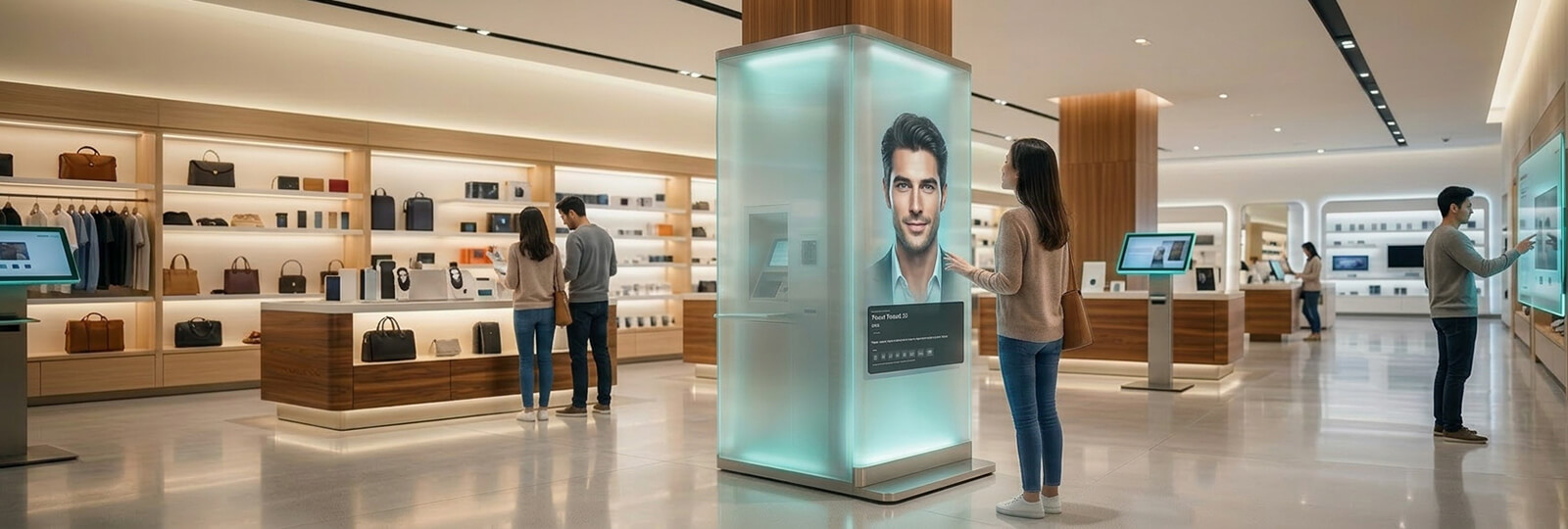
Retail is at a turning point. Staffing shortages, rising e-commerce competition, and growing customer demands for seamless in-store experiences are forcing brick-and-mortar retailers to fundamentally rethink their approach to the point of sale. Against this backdrop, EuroShop 2026 in Dusseldorf, Germany — the world's leading retail trade fair — served as a powerful showcase of where the industry is heading.
eyefactive, Hamburg-based pioneer of interactive digital signage technology and provider of the world's first B2B app platform for professional large-scale multi-touch systems, shares its perspective on the most important retail technology trends of 2026 and beyond.
This whitepaper examines six key trends — from interactive retail media and self-service kiosk solutions to smart sensors, integrated POS systems, advanced retail analytics, and artificial intelligence — identifying what is already happening in stores today, what is gaining momentum, and what will define the retail experience by the next EuroShop in 2029.
Whether you are a retailer seeking to future-proof your stores, a technology partner looking for the right software platform, or a decision-maker evaluating the ROI of digital transformation, this report provides data-backed insights and a practical outlook on the smart retail technologies that will matter most in the years ahead.
Key take-aways at a glance:
Retail Trend 1: Interactive Retail Media
In-store screens are no longer just décor — they're revenue-generating media channels.
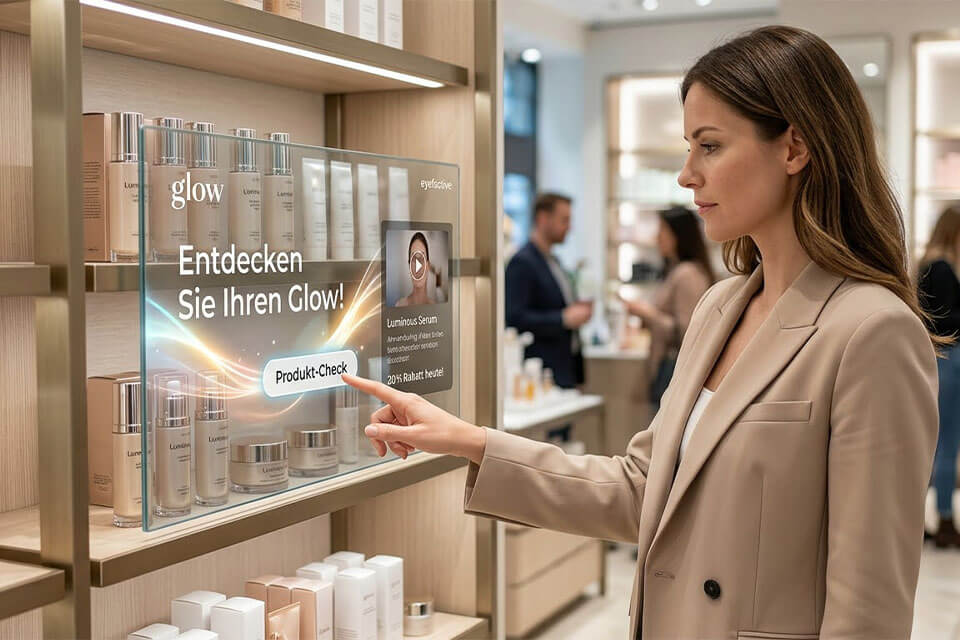
Looking ahead to 2026, interactive retail media has evolved from an experimental add-on into one of the most strategically significant growth drivers in the digital signage and retail technology ecosystem. In-store screens and interactive self-service touchpoints are increasingly treated as premium advertising real estate — allowing brands to run highly targeted campaigns directly at the shelf, at the moment of purchase decision, and in front of verified, first-party shopper data.
What was once a niche advertising format has become a core budget line for major retailers and brand partners alike. According to invidis, retail media has evolved from a side project into a strategic cornerstone for retailers — a shift that is visible in every major market in 2026. U.S. retail media is projected to grow from 62 billion dollars in 2025 to approximately 98 billion dollars by 2028, with three-quarters of U.S. advertisers planning to increase their retail media budgets this year.
The in-store dimension of retail media is particularly relevant for interactive digital signage providers like eyefactive. While 80% of consumer spending still happens in physical stores, 90% of retail media advertising remains digital-online — a significant imbalance that represents a major growth opportunity. In-store retail media screens and interactive self-service touchpoints are already projected to surpass 500 million dollars in 2026, and Europe's total retail media spend is forecast to reach EUR 31 billion by 2028.
What differentiates interactive retail media from classic digital signage is precisely the interactivity layer. Customers who engage with touchscreen displays leave behind a rich trail of interaction data — comparable to click data on e-commerce websites — which provides retailers and brand partners with unprecedented insights into in-store purchase behavior. For eyefactive, this is where the app-based platform and its integrated touch analytics capabilities offer a tangible edge: turning screens from passive cost centers into measurable revenue drivers.
Retail Trend 2: Interactive Self-Service Kiosk Solutions
The hardware race is over. Software wins the self-service marathon.
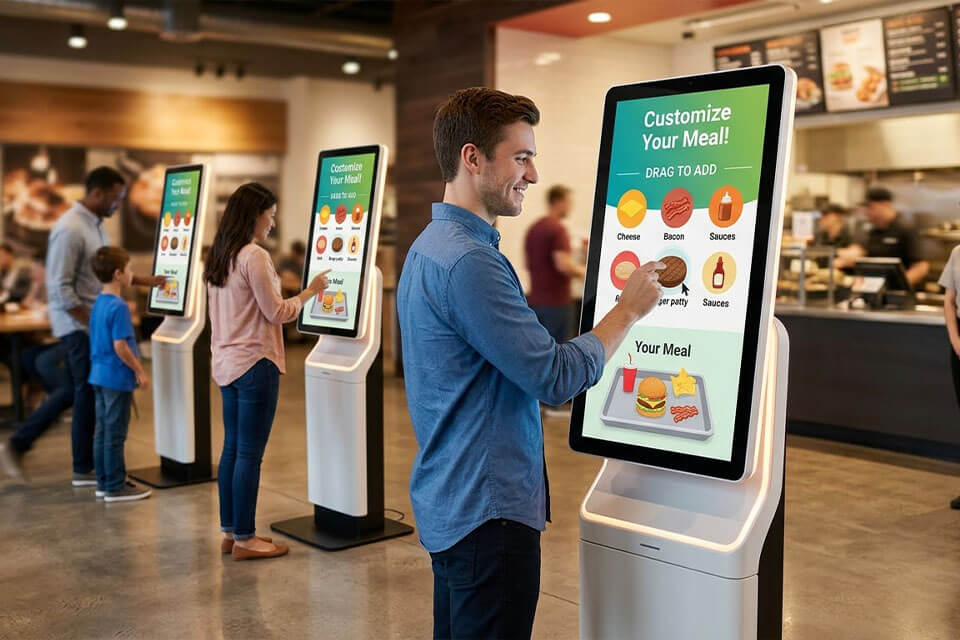
If one trend defined the halls of EuroShop 2026 more than any other, it was the sheer proliferation of self-service kiosk hardware. In stark contrast to EuroShop 2023, where only a handful of companies were presenting interactive self-service kiosks, Hall 6 in Dusseldorf this year was lined with kiosk terminal manufacturers at every corner — a visible signal that self-service solutions have crossed the threshold from early-adopter technology to industry standard.
The numbers confirm this momentum. The global retail self-service kiosk market, valued at USD 25.59 billion in 2025, is estimated to reach USD 27.96 billion in 2026 and grow to USD 37.8 billion by 2030 at a CAGR of 7.8%. Driven by persistent labor shortages, rising operational costs, and changing consumer preferences — over 77% of shoppers now prefer self-service touchscreen solutions for speed and autonomy — the business case for self-service at the point of sale has never been stronger.
Interactive self-service kiosks do more than streamline checkout. They enable customers to independently discover products, configure options, access extended assortments beyond physical shelf space, and receive personalized recommendations. McDonald's reported a 30% rise in average order value after introducing self-order kiosks. A self-checkout system can reduce checkout wait times by up to 40%, and one self-service station allows a single staff member to oversee up to four terminals simultaneously, cutting labor costs significantly during peak hours.
But here's the pivotal question this trend raises for the industry: when everyone offers similar kiosk hardware, where does the innovation come from? The answer — and this is where eyefactive's perspective is unambiguous — is software. The metal box is a commodity. The brains inside it are not. Kiosk software that delivers genuinely intuitive, brand-aligned, interactive experiences; that integrates seamlessly with product databases, loyalty systems, and e-commerce backends; that captures rich interaction analytics and feeds them into real-time decision-making — that is where the self-service race will be won or lost. The companies that understand this distinction in 2026 will be the ones leading the market in 2029.
Retail Trend 3: Smart Sensors & Intelligent Displays
When the display knows who's in front of it, everything changes.
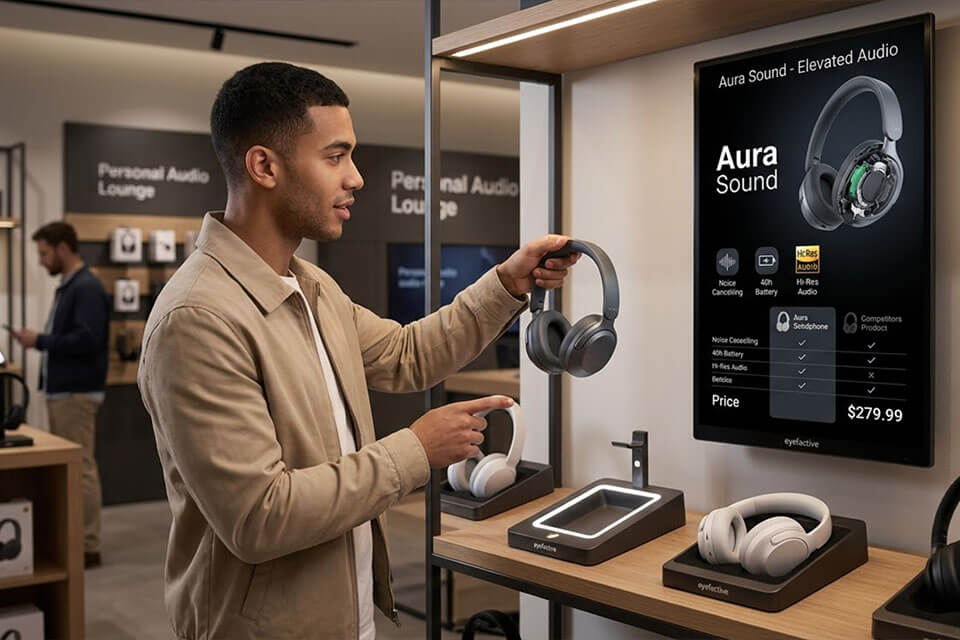
A further area of development for eyefactive in 2026 is the integration of smart sensor technologies with interactive displays. Motion sensors, lift-and-learn solutions, camera-based tracking, RFID, and other IoT components can dynamically influence content on digital signage and self-service systems — for example by adapting promotions to customer frequency, responding to product interactions in real time, or triggering personalized content based on proximity or demographic signals.
The IoT in retail is no longer a future concept — it is a self-sufficient economy growing at an estimated 25.9% annually. Sensors, cameras, and virtual smart shelves as endless aisles have become standard tools in forward-thinking stores, and the data they generate is transforming the way retailers understand shopper behavior. Retailers using shelf-level motion sensors and heatmap tracking have reported up to a 28% lift in basket value by shifting promotional displays based on dwell-time data. Beacon-triggered campaigns have shown 16% conversion lifts in McKinsey research, and interactive displays boost customer engagement by an average of 60% compared to static alternatives.
Digital signage thus becomes an intelligent interface between space, product, and user — transforming the physical store from a static environment into a responsive, personalized retail experience. For eyefactive's platform, this sensor integration is a natural extension of its existing touchscreen object recognition technology. The ability to seamlessly combine passive marker chips, motion-triggered content, and touch analytics within one platform is a unique technological differentiator that enables creative solution partners to design genuinely innovative in-store experiences at manageable cost.
The challenge ahead is not technological feasibility — most of these sensor integrations are already possible — but rather the ability to make sense of the resulting data, act on it intelligently, and integrate it across systems in a privacy-compliant manner. Retailers who solve this data orchestration challenge early will have a significant competitive advantage in the years ahead.
Retail Trend 4: The Integrated POS & Unified Commerce
The future of retail has no silos — only seamless journeys.
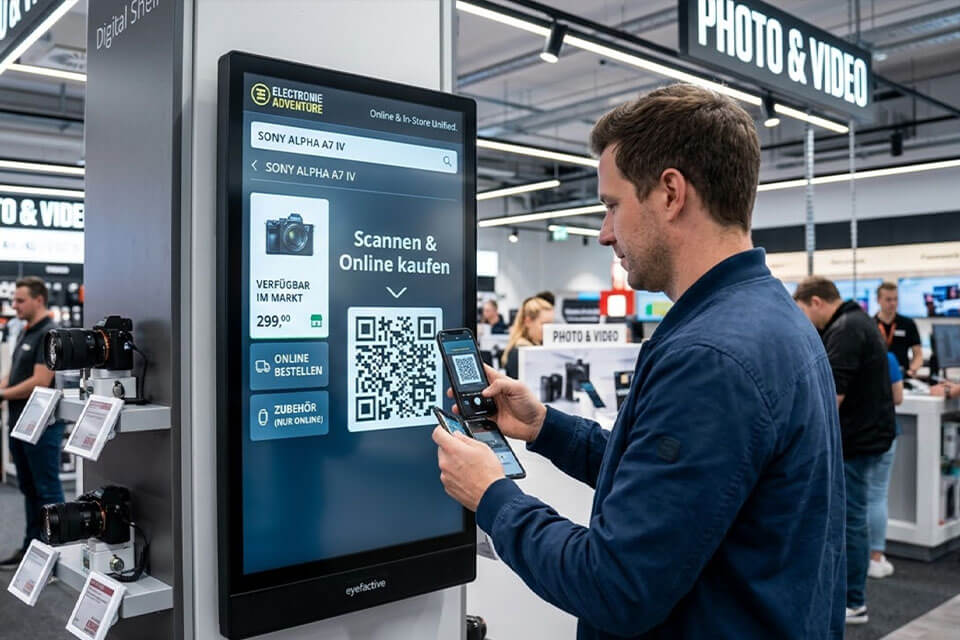
Standalone interactive self-service solutions — no matter how efficient — are only part of the story. True retail transformation requires seamless integration between interactive in-store applications and the broader digital commerce ecosystem. Interfaces to cashier systems, product information management platforms (PIM), e-commerce solutions such as Shopify, and ERP systems are key to implementing real omni-channel scenarios at the point of sale.
Unified commerce — where back-end systems including POS, e-commerce, inventory, and customer data all operate from a single integrated platform — is rapidly moving from a competitive advantage to an operational necessity. Global retail e-commerce sales are projected to reach USD 8.1 trillion, according to Statista. Against this backdrop, the gap between online and offline retail experiences is no longer acceptable: 73% of all consumers cite customer experience as an important factor in their purchasing decisions, and one in three say they will leave a brand they love after just one bad interaction.
For eyefactive, this trend directly validates the strategic direction of its headless API platform approach. By offering extensive interfaces and API connectors to common databases, CMSs, and e-commerce platforms, the eyefactive touchscreen app platform allows retailers and solution partners to keep running their existing tool stack while adding a powerful interactive layer on top. Customers should be able to move seamlessly from interactive in-store applications to mobile and online environments — and retailers should maintain full control and transparency across all touchpoints.
Research from Shopify shows that businesses using a unified commerce approach see 22% better total cost of ownership, 20% faster implementation times, and significant reductions in middleware expenses. With this positioning, eyefactive becomes an enabler of interactive unified commerce experiences — connecting the physical touchscreen with the digital back-end in one coherent, manageable solution.
Retail Trend 5: Advanced Retail Analytics
Data without insight is noise. Data with the right tools is a competitive advantage.
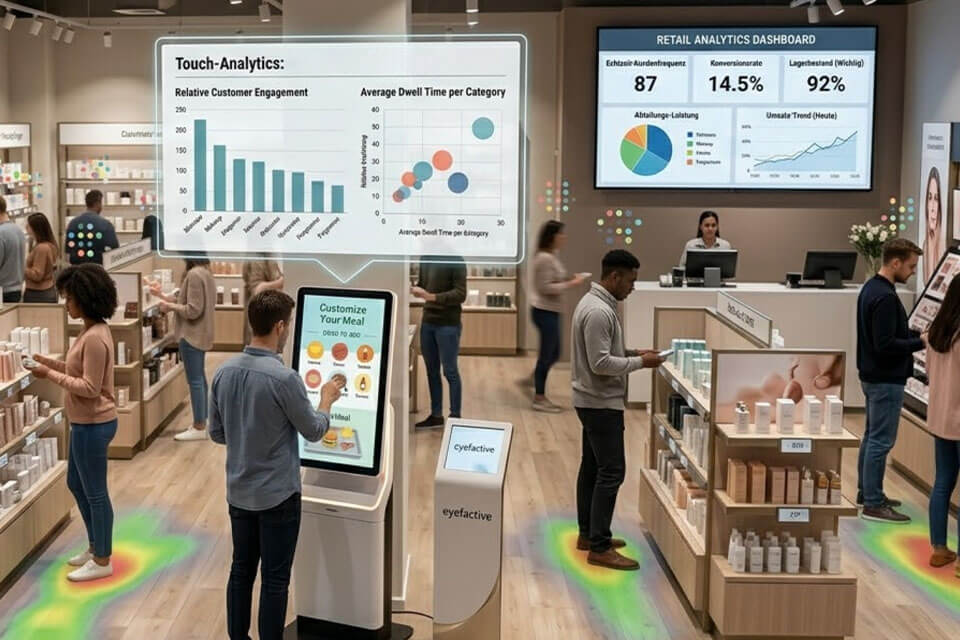
The rise of interactive self-service kiosks, smart sensors, and integrated POS systems is generating more in-store data than ever before. The strategic question for retailers in 2026 is no longer whether they can collect this data — it is whether they have the tools and organizational capability to turn it into actionable insights that measurably improve performance at the point of sale.
The global retail analytics market is forecast to generate USD 13.2 billion in revenue in 2026 alone, growing to USD 26 billion by 2030.[3] By the end of 2026, 35% of retailers are projected to adopt real-time inventory management analytics. AI and machine learning are becoming central to this transformation.[2]
For eyefactive, touch analytics represent a particularly powerful and differentiated capability. Touch input data — who taps what, when, how often, and in what sequence — is functionally comparable to click-data on e-commerce websites: highly granular, intent-rich behavioral data collected at exactly the moment of purchase consideration. eyefactive's cloud-based analytics platform collects this data across all connected systems and makes it available for analysis in business intelligence tools such as Microsoft Power BI or Adobe Analytics.[1]
Retail Trend 6: AI in Retail
AI is the buzzword of 2026. At the POS, it's still mostly a promise — but a very credible one.
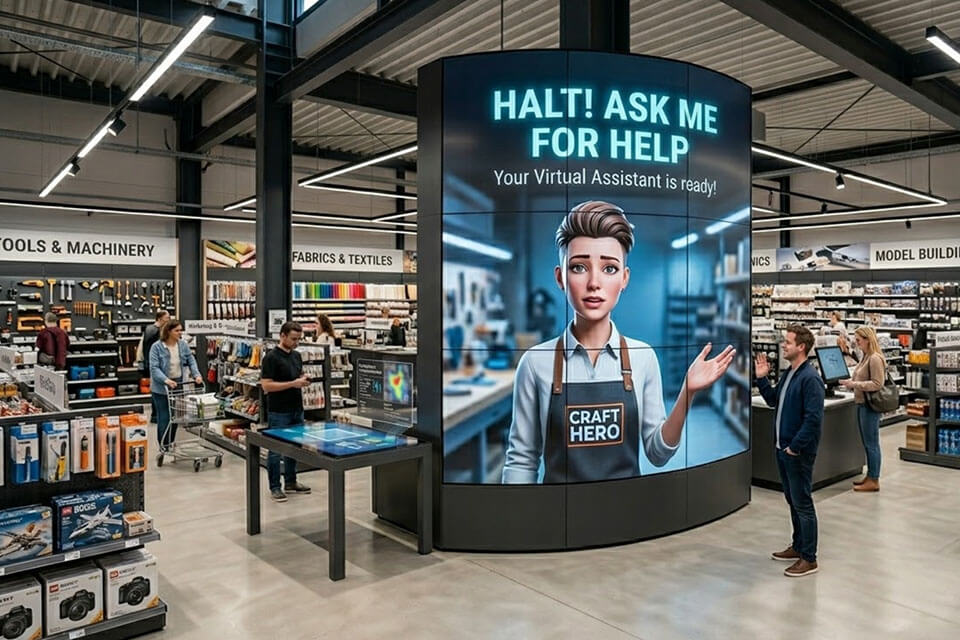
No technology discussion in 2026 is complete without addressing artificial intelligence — and retail is no exception. Yet a candid observation from the show floor is equally important: despite the sky-high expectations, actual deployed AI implementations in everyday retail were difficult to find at EuroShop 2026.[4] A few demos showcased virtual assistants chatting with customers or AI-driven product recommendations, but most remained more concept than concrete.
For eyefactive, AI represents both a near-term content opportunity and a medium-term platform integration challenge. In the near term, AI-generated content creation for touchscreen applications and AI-driven personalization of product recommendations within the app platform are natural applications. In the medium term, the deeper integration of conversational AI interfaces with eyefactive's multi-touch software and sensor layer — creating genuinely intelligent, context-aware in-store experiences — is the strategic direction that will define the platform's next evolution.[5] The groundwork is already in place: the proprietary native software technology, the sensor integrations, and the cloud analytics backbone are the essential ingredients.
Summary & Outlook: Retail 2026 - 2029
The six trends presented in this whitepaper — interactive retail media, self-service kiosk solutions, smart sensor integration, unified commerce connectivity, advanced retail analytics, and AI — are not isolated developments. They are converging layers of a fundamentally new retail architecture: one where the physical store becomes as intelligent, measurable, and personalized as its digital counterpart.
EuroShop 2026 confirmed that the industry has crossed a critical inflection point. Self-service hardware is now mainstream — which means software, user experience, and data intelligence will be the decisive differentiators going forward. Retail media is becoming a profit center, not just a communication channel. Smart sensors are transforming stores from static environments into responsive, real-time systems. And unified commerce integration is no longer optional for retailers who want to deliver consistent customer experiences across all touchpoints.
Looking ahead to EuroShop 2029, three shifts seem most likely to define the next chapter of retail technology:
eyefactive is well positioned for this trajectory. With its proprietary native multi-touch software technology, its growing cloud platform, its app-based no-code CMS, its sensor integrations, and its headless API approach, the company offers solution partners and retailers alike a powerful, future-ready foundation for the interactive point of sale of tomorrow.
The physical store is not dying. It is becoming smarter. And the retailers who invest in the right interactive technologies today will be the ones defining the standard by 2029.