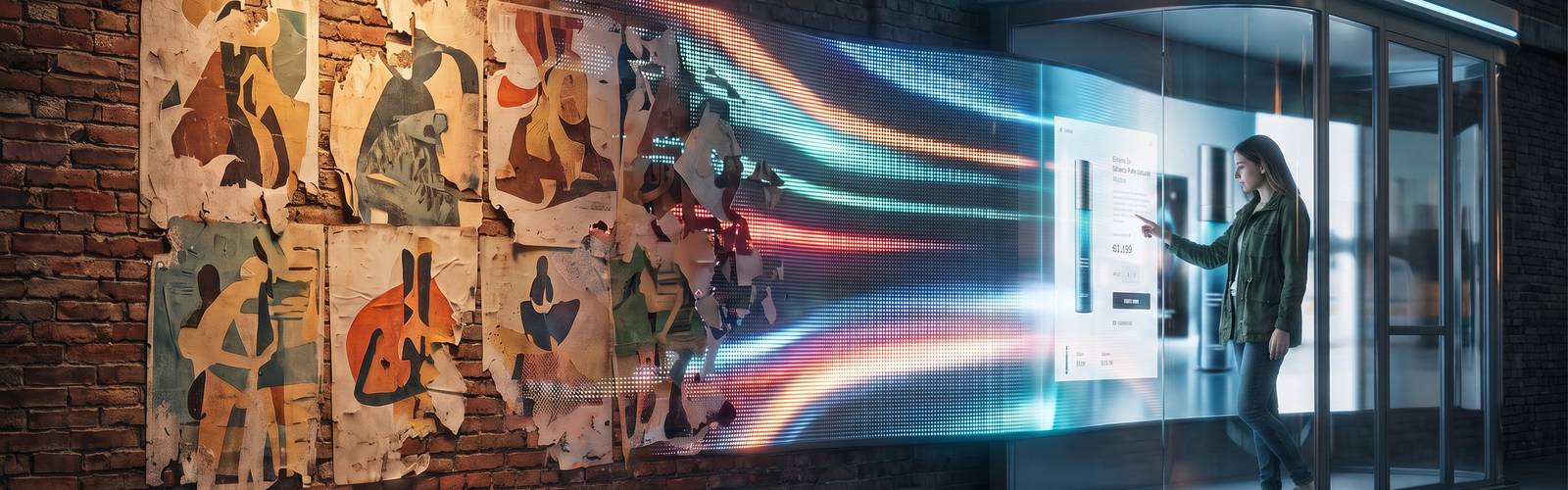
Not long ago, a "sign" was a static poster that could be changed only by someone climbing a ladder to replace it. Today, that wall spot can respond to shoppers, update its message hourly, and even sell ad space. That's three revolutions stacked together. Digital signage replaced paper with pixels. Interactive digital signage then gave shoppers control of those pixels. And now, retail media is turning every one of those interactive screens into a new revenue line for the store itself. Understanding where signage came from and where retail media fits into that story is the first step to using it well.
In short:
Signage has evolved from printed posters to programmable digital screens to touch-based interactive displays and now to retail media, where retailers sell screen time as advertising space at the point of sale.
In this article, you will learn:
-
The evolution from analog to digital to interactive signage, and retail media as its newest branch.
-
Interactive and retail media signage measurably drive engagement, sales, and ad revenue that static signage cannot.
-
For retailers, museums, hotels, and any brand managing physical customer touchpoints.
What Is Digital Signage?
Digital signage refers to displays, like LCD, LED, or projection-based, that show digital content such as images, video, or live data instead of printed material. It is sometimes called DOOH, or digital out-of-home advertising, when used in public spaces. Content can be scheduled, swapped, and controlled remotely, which is the first big advantage over anything printed: a network operator can update hundreds of screens at once instead of reprinting and re-hanging posters.
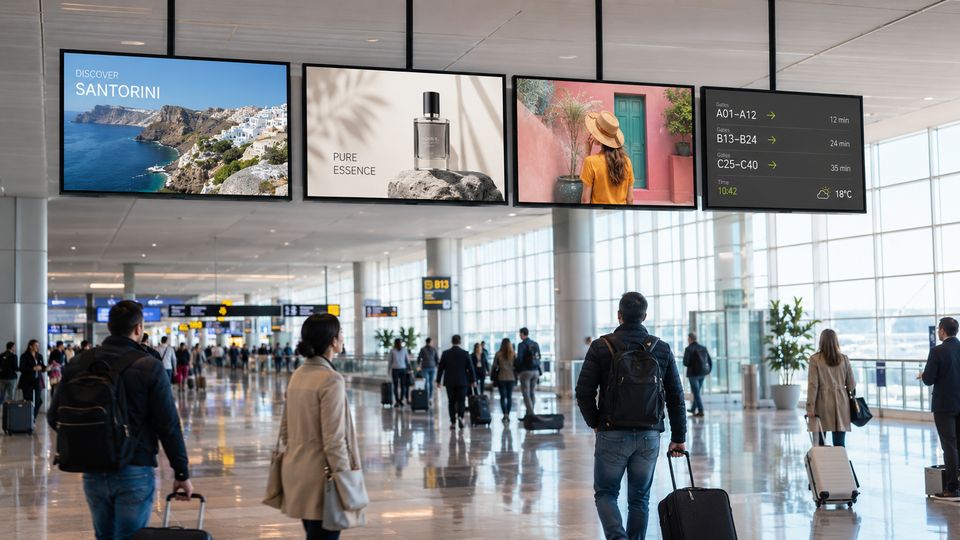
From Analog to Interactive: A Signage Timeline

Interactive digital signage did not appear overnight. It is the third stage in a longer shift that reshaped how businesses communicate at the point of sale, in lobbies, and in public spaces:
But, each stage did not fully replace the one before it. Many stores still run static posters alongside digital screens and interactive kiosks. What changed is which layer carries the most value for the business.
Interactive Signage: The Next Step in Marketing Technology
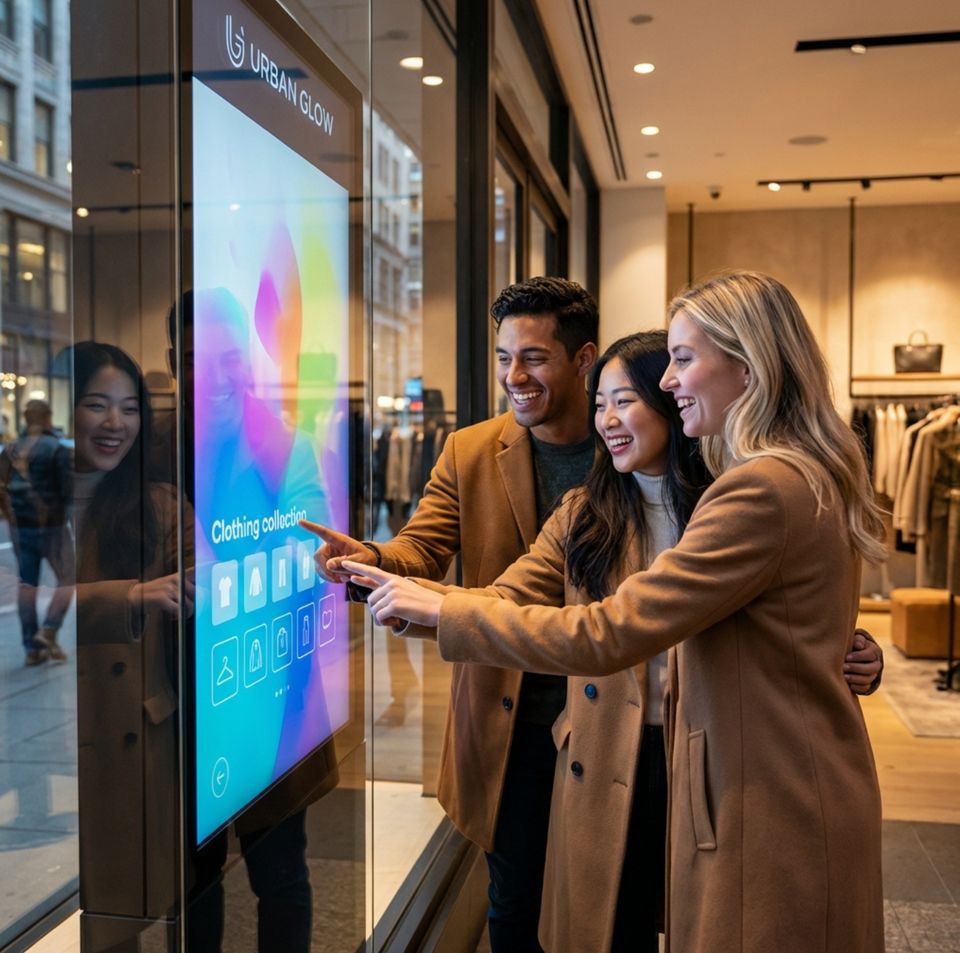
As digital signage reduced the reliance on printed material, interactive digital signage went a step further by shifting control to the consumer. Shoppers, used to touch gestures from smartphones and tablets, adapt to large-format touchscreens with little to no learning curve. Instead of waiting for information to loop back around on a static display, they can search for exactly what they need, when they need it.
This shift matters for point-of-sale, shopping portals, and tableside menus alike: businesses can personalize the customer experience without adding headcount. Combined with improving audience analytics, interactive digital signage software can adapt messaging based on demographic trends and consumer behavior, closing much of the gap between the in-store and online experience.
Retail Media: A Special Case of Interactive Signage
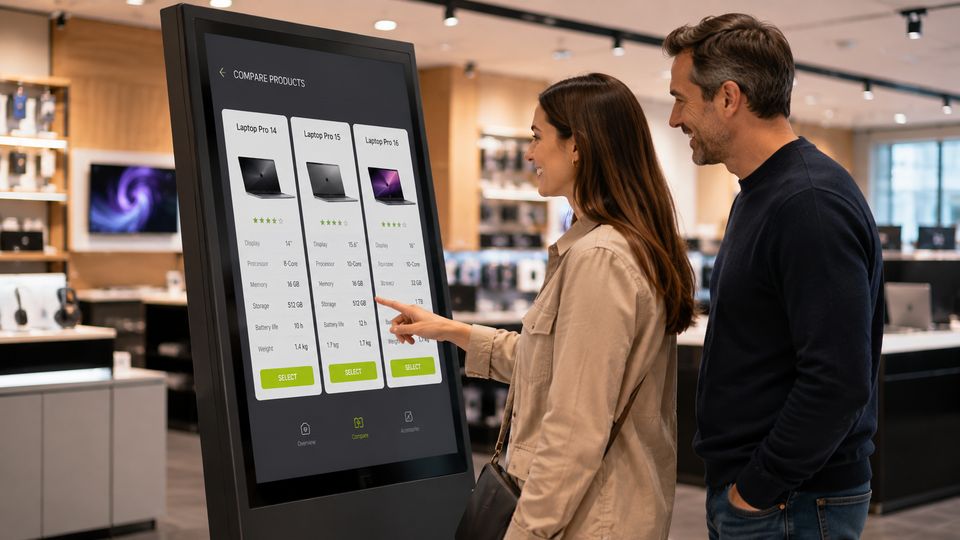
Retail media is what happens when an interactive screen at the point of sale stops being purely a customer-experience tool and becomes an advertising channel in its own right. Instead of helping shoppers browse products, the same screen can also display sponsored content, brand placements, or promotions sold by the retailer to brands, much like search or social ads are sold online.
The category is large and growing fast: the global retail media market is projected to reach roughly $203.9 billion in 2026, a 14% year-over-year increase, according to Coresight Research[3]. Most of that spending today still goes to online placements. In the U.S., in-store retail media accounted for just 3.3% of the remaining (non-Amazon) retail media spend in 2025, per eMarketer[4]. But, in-store is widely flagged by analysts as the "next major growth frontier"[5], precisely because roughly three-quarters of purchases still happen in physical stores.
What makes retail media a special case of interactive signage rather than a separate technology is the data layer underneath it. A static poster cannot prove anyone looked at it. An interactive touchscreen can register taps, dwell time, and product interest.
That's the same kind of "click data" online retailers have used for years, giving retailers a way to sell that attention with real numbers attached. eyefactive's cloud-based touch analytics, for example, work on this exact principle: touch input at the screen is tracked and made available for business-intelligence analysis, the same kind retailers already run on their e-commerce click data[6].
Interactive Digital Signage Today: Personalization at Scale
Between video analytics, beacons, wifi triangulation, opt-in apps, and social media data, there is no shortage of information that can now be streamed to interactive touchscreens. Combined with real-time traffic data, polling, and sales figures, this creates a wide range of options for tailoring what a screen shows and to whom, while keeping the experience dynamic and user-friendly rather than static and generic.
Live social feeds on multitouch display walls, real-time schedules on video walls, and dynamic wayfinding at smart-city info points all reflect one principle: information that is always current and focused on what users need now.
A Bright, Measurable Future
The global interactive display market is valued at $52.14 billion in 2026 and is forecast to reach $76.48 billion by 2031, with a CAGR of roughly 8%, according to Mordor Intelligence[2]. Growth is being driven in large part by retail and hospitality, the fastest-growing end-user vertical in that forecast, alongside continued smart-city and public-sector rollouts.
The direction is clear across every layer of this timeline: printed signage is steadily being replaced by digital signage, which is evolving into interactive formats[1]. As a result, interactive screens at the point of sale are increasingly expected to pay for themselves by serving as retail media channels. For businesses evaluating where to start, there's no longer any guesswork: the technology, analytics, and advertising models needed to monetize interactive displays are already in place.
| Type | Content Control | Audience Role | Measurable Data | Typical Use |
|---|---|---|---|---|
| Analog / Printed | Manual (reprint & replace) | Passive viewer | None | Posters, price tags, banners |
| Digital Signage (DOOH) | Remote, scheduled | Passive viewer | Impressions / dwell estimates | Video walls, digital menu boards |
| Interactive Digital Signage | Remote + user-driven | Active user | Touch data, session behavior | Kiosks, self-service terminals, touch tables |
| Retail Media (on interactive signage) | Remote + user-driven + sold ad space | Active user & ad audience | Touch data + attributable sales impact | Sponsored in-store screens, brand placements at POS |
Digital signage displays content on a screen that the viewer cannot control, similar to a TV. Interactive digital signage adds a touch-based feedback layer, allowing viewers to search, select, and navigate content directly on the screen.
Retail media is the practice of selling advertising space on a retailer's own channels, including in-store interactive screens to brands, using data from those screens to prove the ads were seen and, increasingly, that they drove sales.
No. While most retail media spend today is online, in-store retail media, including interactive digital signage at the point of sale, is considered one of the fastest-growing segments of the category, since it reaches shoppers at the moment they are deciding what to buy.
Signage moved through three broad stages: printed, static signage that required manual replacement; digital signage that could be updated remotely but not controlled by the viewer; and interactive digital signage, which lets the viewer directly operate the content via touch.
Interactive signage can record what a user actually taps on, how long they engage, and what they search for. This is comparable to click data on a website. Standard digital signage, by comparison, can typically only estimate that a screen was viewed.
Providers such as eyefactive offer touchscreen software platforms, including cloud-based touch analytics, that let retailers combine interactive customer experiences with the data needed to run and measure retail media at the point of sale.